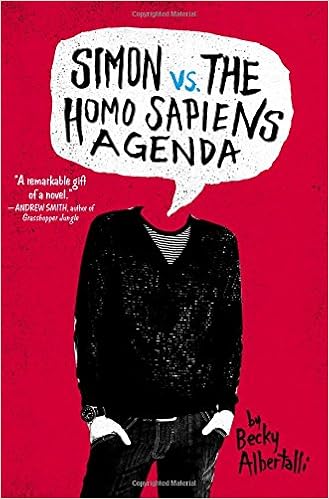
Simon vs the Homosapien Agenda

Simon vs the Homosapien Agenda
By: Becky Albertalli


Release Date: April 17, 2015
Pages: 320
Grades- 8 and up

Awards
William C. Morris Award Winner
National Book Award Longlist
The Story 

Simon is a normal sixteen year old living in Georgia.

His family watches the Bachelor religiously


He has a Golden Retriever named Bieber (Named after Justin Bieber to be exact)


He is a huge Harry Potter fan


....and he is gay.

He isn't ready to tell anyone yet though. The only person that knows is Blue. Simon met Blue over an anonymous Tumbler page. Blue is gay too and goes to Simon's school, but they are anonymous to each other. Their quiet friendship is only evident within the emails they share with one another. One day, a classmate named Martin finds Simon's email pulled up on the library computer. He approaches Simon and tells him that he knows he is gay and found his emails to Blue.

He will expose Simon to the school, unless he helps him to get with Simon's friend Abby. Cornered, Simon agrees to help.

Simon must now try to get his friend Abby to date Martin all the while trying to hide his secret and protecting Blue, but who is Blue?

Strengths

I hate to admit it, but I don't read much LGBT literature. The LGBT books that I have read were just strictly about how the character was a lesbian, gay, bisexual or transgender. This really annoyed me because there is so much more to a person then this. What I loved about this book is that the character Simon is well developed.  He is just a normal kid.
The character has a wonderful family, hilarious friends, and is passionate about drama.

The bigger theme of this book is being afraid of showing your true self.  It was brilliant! I think this is a universal theme that a lot of people can relate to.

I also really enjoyed the mystery of trying to figure out who Blue was.
I stayed up late with Simon trying to figure it out.  (At one point I suspected everyone). When it was finally revealed, I flipped back through the book looking for clues that I might have missed.

What a great story!

Weakness 

There is a lot of swearing.
It is characteristic of the character, but for reader's advisory it is something to make note of.

Favorite Quote 

I don't remember openly giggling to a book in a long time.
This book had so many hilarious and relatable  quotes.

One of my favorite is:

"Awkwardness achievement unlocked." 
"Should we be filming this?"

Overall

This book is delightful. I would recommend it for grades 9 and up.

With its incredible plot line I can see why it was the winner of Morris Award.
 I look forward to sharing this book with my teens. 


When Mischief Came to Town by Katrina Nannestad


Goodreads Synopsis

In the tradition of ANNE OF GREEN GABLES and PIPPI LONGSTOCKING comes a heart-warming novel about love, family, grief, joy and the power of laughter and imagination. When Inge Maria arrives on the tiny island of Bornholm in Denmark to live with her grandmother, she's not sure what to expect. Her grandmother is stern, the people on the island are strange, and children are supposed to be seen and not heard.   But no matter how hard Inge tries to be good, mischief has a way of finding her. Could it be that a bit of mischief is exactly what Grandmother and the people of Bornholm need?

Review

First of all, isn't the cover gorgeous? I was in love from the moment I saw it...
 Poor Inge Maria. She doesn't mean to cause trouble, (well, most of the time,) but mischief is determined to find her. If you are searching for a book fraught with hijinks and short, humorous accounts, When Mischief Came to Town is the story for you. The quirky writing is both occasionally shocking (perhaps due to cultural differences) and charming. Nannestad weaves a tale reminiscent of Pollyanna and Pippi Longstocking, that is simply hilarious. There are very few books that make me laugh out loud, but this was one of them! I found several incidents rather disturbing, such as Henry the turkey's almost early demise. In addition, Grandmother's parental skills are cold and fairly questionable in the beginning. Furthermore, Inge Maria is never truly made to face consequences for her not-always-innocent actions. However, the humor and heart of this story overcome most my misgivings and I would recommend this story to anyone looking for a good laugh!

Disclosure: I read an Advanced Reader Copy received from the publisher.

Lizzie and the Lost Baby by Cheryl Blackford


Goodreads Synopsis

Cheryl Blackford's debut novel is set in England during World War II and told from the dual perspectives of ten-year-old Lizzie, a homesick girl evacuated from bomb-blitzed Hull to the remote Yorkshire valley, and Elijah, a local gypsy boy. When Lizzie discovers an abandoned baby, her dangerous friendship with Elijah is put to the test. Will Lizzie be able to find the baby's parents? And if she does, can she and Elijah remain friends in a world clouded by prejudice and fear?

Review

Lizzie and the Lost Baby delves into an issue of prejudice that has been haunting Europe for centuries, but is not often discussed. Gypsies have been treated with disdain since medieval times, sometimes because of wrongs they have committed, but other times simply because of who they are. In the case of Elijah's family, it seems the prejudice is due more to who they are than their actions. The way the village folk deal with his family is reminiscent of the treatment of African Americans in the United States received before the civil rights movement. It was refreshing to read a novel acknowledging this problem. (The only other story I can think of off the top of my head that addresses this is The Hunchback of Notre Dame.) Have you read any books that have handled this issue well? 

Despite the interesting topic, the character development throughout the entire book is poor. I found myself having a difficult time remaining interested in any of the characters and their problems, because they were so one-dimensional. Frankly, I was bored with this book. I first learned about Lizzie and the Lost Baby from a webinar and was quite intrigued. A book addressing prejudice against gypsies and displaced English children during the Blitz sounded like an engaging read for this history buff. Unfortunately, even my love for history could not overcome the lack of magic in this forgettable novel.

Disclosure: I read an Advanced Reader Copy received from the publisher.

What are your favorite current middle grade novels set in WWII?

Alyssa

An Interview with Lindsey Leavitt & Robin Mellom

Please welcome Lindsey Leavitt & Robin Mellom to Tween You & Me! 

The Pages Between Us 

22042804


About the book (from the publisher) 

Told in letters, posters, blog posts, homework assignments, and more, The Pages Between Us is a totally fun, totally earnest snapshot of middle grade friendship—and what it truly means to be there for someone during the ups, downs, and everything in between.

Piper and Olivia have been best friends since…well, forever. But they're distressed to find that their new middle school schedules aren't giving them enough together-time. Luckily, an idea sparks when Piper finds a cute, sparkly notebook to disguise as her "French Class" homework. It's genius—now the two BFFs can stick together all the time. And document their adventures—you know, for anthropology's sake.

But as the two navigate the tricky new world of sixth grade, they realize that they may need to branch out more than they originally thought. Their notebook, once a life raft, begins to feel like a big responsibility. Can they grow up, without growing apart?


Q&A Questions


1. What inspired you to write The Pages Between Us? 
Did you draw on memories or events from your own life?

Robin: When I was in junior high, my BFF and I kept a secret journal. We exchanged it between classes and made it look like it was a boring old history notebook. At first we wrote general “how my day is going” letters. But then it moved on to writing fiction for each other. Sometimes we would give each other a prompt and the other had to write the most bizarre story about it. Like: Write a story with the Pope and Papa Smurf as best friends. It got strange. But it was a blast! Later, when I became a writer, I wanted to use that notebook idea but I knew it would take another writing partner to do it justice. A perfect writing partner. I knew Lindsey through writing conferences and I loved her writing. I also knew her sense of humor was sassy, smart, and well...perfect. I popped the question and she accepted! We wrote emails to each other in the voice of 12 year old girls Piper and Olivia. After a while we had a book-size amount of emails. What I loved most was trying to make Lindsey laugh...just the way I’d tried to make my BFF laugh all those years ago.

Lindsey: YEP! See above :)

2. What do you hope kids will take away after reading your work?

Lindsey: 2 things: 1. Girls are funny. They’re not just funny “for a girl”. They are funny regardless of age, gender, or looks. And there are lots of different ways to be funny, and one of the BEST feelings is finding a friend who shares your sense of humor (amiright, robin?) 2. Just because your problems might seem small to someone else, doesn’t mean they aren’t big and valid to you. Middle school can be scary in so many different way, but it can also be fun.

Robin: I hope kids will see that we ALL feel worried when big changes happen. But finding the humor in those moments will help you through. Having a friend--a true and loyal friend who “gets” you--will always make anything that feels impossible...actually become...possible.

3. What were you like when you were a tween? 
Did you have any favorite authors that inspired you?  

Lindsey: I wore my hair the same way almost every day--half up/half down. Someone asked me what I looked like with my hair down, and I was scared to do a noticeable change, so I never wore my hair down. My pants were always too short. I was loud around boys I liked. I was loud around boys I didn’t like. I wrote letters to my future self, who lived on a farm and was married to a rancher from Montana (spoiler: didn’t happen). I was scared of failure. I loved my family, friends, and church. I never ate vegetables.


Robin: I was always the shortest and quietest kid in class. But in eighth grade I grew like a weed and was suddenly the tallest (but still rather quiet) (unlike Lindsey). But like Lindsey, my pants were always too short. My shins hurt. Mom would put a warm cloth on my legs at night and make me drink milk. She said it was the best way to deal with growing pains, but there was no internet back then so I’m sure she was just making it all up. I wrote stories and drew the cover and named the chapters. But I never shared them with anyone. I read Judy Blume. Over and over.


4. How has your teaching backgrounds helped you as a writer?

Lindsey: The best way for me to learn anything is to teach it. When I taught fifth grade, we wrote fractured fairy tales and I had to contribute a character. If the kids researched a state, so did I. I wrote during journal time. I read during reading time. And I worked through the revision process over and over again. That was a lot of my education before I began writing professionally. But mostly, teaching kids of all ages reminded me what my own fears and dreams were at those ages. As an author, it’s vital that I preserve that.Oh, I just read what Robin wrote. That too (YES, Robin answered most of these questions first. She is the star student in this pairing).


Robin: I spent several years teaching fifth grade. The following year they would move on to this strange and scary place called “Middle School.” I had to prepare my fifth graders for the transition and it was during this time in my life when I would answer their questions about all the changes they were about to face, that I realized this was a topic I wanted to write about. Being a tween...and dealing with change. I am weirdly/strangely/proudly obsessed with writing about kids who must deal with change.


5. Here at Tween You and Me, we believe strongly in advocacy for tweens. What advice would you offer librarians and other professionals who would also seek to be tween advocates?


Lindsey: I have 2 eleven-year-old daughters  (one biological, one step) who have super different interests and personalities. Sometimes we worry one kid isn’t growing up fast enough. Sometimes we worry the other daughter is growing up too fast! I really have to remind myself that they are individuals who will grow, develop and learn at their own speed and to make sure I’m not pushing them up or down. Middle school is such a balancing act that way, and I really applaud middle school librarians who create and atmosphere with literature and activities that appeal to such a broad range.


Robin: Tweens can be deeply thinking individuals. They are starting to ponder the BIG questions in life. What makes me happy? Is this feeling normal? How do I figure out who I am? So advocates should listen, listen, listen. Ask tweens for their input, their suggestions, their ideas. And also respect their need for silliness and fun. NO ONE knows how to have a good time like a group of tweens.   

6. You have a lot of new books coming out! Would you like to talk about those?

Lindsey: Yep! Robin and I are working on final revisions for the the next Pages Between Us book! She’ll tell you more. She’s good at that. In addition, I have a new early chapter book series releasing in May called COMMANDER IN CHEESE. It’s about a mouse family that lives in the White House and ohh, it’s adorable.


Robin: Book 2 of THE PAGES BETWEEN US gets wild and weird and it all surrounds the school’s Battle of the Books. If you’ve ever held one of these battles at your school, this book will make you snicker. At the same time, we dig deeper into Piper’s emotional life at home and Olivia’s vision of who she is and how she fits into this world. In addition, I have another new middle grade novel releasing next year titled CONFESSIONS FROM THE PRINCIPAL’S KID. (Yep, I was the kid of a principal.)

7. If you could go back into time and give your tween self some advice, what would it be? 

Lindsey: Let your hair down. Literally.

Tween Robin: That time when your dad cut your hair, it was cute. There was no need to wear turtlenecks in an attempt to hide your new bob. Just own it. In fact, anytime you’re worried about what other people think of you, remember that they also poop and burp and fart...EVEN THE COOL ONES. We are all humans...your job is to be a happy one. YOU GOT THIS.

Thank you so much for stopping by Lindsey & Robin!

If you would like to know more about these amazing ladies, please visit  Lindsey & Robin's websites: 

Robin Mellom
Lindsey Leavitt

The Pages Between Us will be on sale February 9th, 2016.  


The Door by the Staircase

The Door by the Staircase 
By: Katherine Marsh 

25685479

Release Date: January 5. 2016
Pages: 288
Age Range: 8 and up 

The Story 
Twelve-year-old Mary Hayes can't stand her orphanage for another night. But when an attempted escape through the stove pipe doesn't go quite as well as she'd hoped, Mary fears she'll be stuck in the Buffalo Asylum for Young Ladies forever. 

The very next day, a mysterious woman named Madame Z appears at the orphanage requesting to adopt Mary, and the matron's all too happy to get the girl off her hands. Soon, Mary is fed a hearty meal, dressed in a clean, new nightgown and shown to a soft bed with blankets piled high. She can hardly believe she isn't dreaming!

But when Mary begins to explore the strange nearby town with the help of her new friend, Jacob, she learns a terrifying secret about Madame Z's true identity.  

Madame Z is the historically terrify Baba Yaga. 

If Mary's not careful, her new home might just turn into a nightmare.

Story synopsis provided by Amazon 

Strengths 

I liked learning about the Russian Folklore that is sprinkled throughout this book. Marsh does a wonderful job of creating a creepy and yet  magical story line. It can be slow at times, but if you hang in there, you will be rewarded with a fantastic story. I especially enjoyed the twist at the end. It reminded me a great deal of Neil Gainman's Coraline. I think it reminded me of this book in regards to the parallel magical world. I would highly recommend paring this book  with a non-fiction book on Russian and Slavic Folklore or on Baba Yaga herself. If you have this history, it will help to make the story more enjoyable. 


Weaknesses 

This isn't for the faint of heart. It is definitely creepy. My biggest concern is finding an audience for this book. Even though it was beautifully crafted, I am not sure who to book talk this book to.  Perhaps if it is marketed as a magical fantasy story? 

Overall 

I am seeing more and more books with Baba Yaga as a central character. In the publishing world, I  think this has become a trend. Although I did find it interesting, I wouldn't recommend it to everyone. 

Baba Yaga

Here are some resources about the origins of Baba Yaga:

Baba-Yaga flying


If you like this book, you might like: 


- Pamela 


How Do Tweens Seek Information?

Have you ever wondered if your tweens have a method for seeking information or if they make random, impulse decisions, and more or less chase squirrels?


I spent an entire semester last year researching information seeking behavior, and in particular, tween information seeking behavior. When I use the phrase "information needs" or "information seeking behavior," I am referring to the search a tween undergoes to access information: a funny cat video on YouTube, a book about the Civil War for a school project, a favorite fictional book, information on how to build a treehouse, or any other myriad of information queries you could imagine! Tweens are as varied in personality and habits as adults. Therefore, what I share with you today cannot necessarily be applied to every single tween; however, I hope it gives you insight into some general observations about the approach this age group takes when attempting to satisfy information needs.

1. Tweens face a plethora of barriers when seeking information

Some of these include: cognitive development, privacy concerns, knowledge of search strategies, and level of discernment. All these barriers are age related and can only be improved by growth and experience. This is why: 

2. Tweens almost always have a more satisfying information seeking experience if they seek the information from or in conjunction with another person.


via GIPHY

3. More often than not, tweens seek information from one another.

(No chance of that going wrong, right?)


4. Socialization often spawns information seeking

Two boys decide to see how many marshmallows they can fit in their mouth at one time, which leads them to discover the world's record for number of marshmallows stuffed into someone's mouth...

via GIPHY

5. The presence of an adult authority figure in an information search with a tween has been found to have positive correlations with increased self-esteem.

So how can we apply this in our work with tweens? Reach out to your tweens and find out what kind of information they are seeking. Remember, tweens will often seek each other out first, before coming to an adult authority figure for help; however, their self-esteem will likely be higher if you are there helping them! When tweens do come to you for help, don't just find the answer, teach the process and let the tweens be involved! Explain your rationale for why you search a certain way and trust specific resources, while taking others with a grain of salt. Most importantly, treat your tweens with the same dignity and respect you would to any adult.

We would love to hear from you! What behaviors have you observed in your tweens as they seek the information they crave?

Alyssa


To Learn More, Check Out Any of These Fabulous Resources:

Anderson, T. D. (2013). Tweens and their in-betweens: giving voice to young people when exploring emerging information practices associated with smart devices. Information Research, 18(1), 1-11.
Bowler, L. (2010). Talk as a metacognitive strategy during the information search process of adolescents. Information Research, 15(4), 13.
Burley, D. (2010). Penguin Life: A Case Study of One Tween's Experiences inside Club Penguin. Journal Of Virtual Worlds Research, 3(2), 3-13.
Crow, S. R. (2015). The Information-Seeking Behavior of Intrinsically Motivated Elementary School Children of a Collectivist Culture. School Library Research, 181-31.
Dresang, E. T. (2005). The information-seeking behavior of youth in the digital environment. Library Trends, 54(2), 178-196.
Fields, D., & Kafai, Y. (2009). A connective ethnography of peer knowledge sharing and diffusion in a tween virtual world. International Journal Of Computer-Supported Collaborative Learning, 4(1), 47-68. doi:10.1007/s11412-008-9057-1
Fisher, K., & Durrance, J. (2003). Information communities. In K. Christensen, & D. Levinson (Eds.), Encyclopedia of community: From the village to the virtual world. (pp. 658-661). Thousand Oaks, CA: SAGE Publications, Inc. Retrieved from http://libaccess.sjlibrary.org/login?url=http://knowledge.sagepub.com/view/community/n248.xml
Fitneva, S. A., Lam, N. L., & Dunfield, K. A. (2013). The development of children's information gathering: To look or to ask?. Developmental Psychology, 49(3), 533-542. doi:10.1037/a0031326
Foss, E., Druin, A., Brewer, R., Lo, P., Sanchez, L., Golub, E., & Hutchinson, H. (2012). Children's search roles at home: Implications for designers, researchers, educators, and parents. Journal Of The American Society For Information Science & Technology, 63(3), 558-573. doi: 10.1002/asi.21700
Gossen, T., & Nürnberger, A. (2013). Specifics of information retrieval for young users: A survey. Information Processing & Management, 49(4), 739-756. doi:10.1016/j.ipm.2012.12.006
Large, A., Nesset, V., & Beheshti, J. (2008). Children as information seekers: what researchers tell us. New Review Of Children's Literature & Librarianship, 14(2), 121-140. doi: 10.1080/13614540902812631
Liu, R., Shen, C., Xu, L., & Gao, Q. (2013). Children's internet information seeking, life satisfaction, and loneliness: The mediating and moderating role of self-esteem. Computers & Education, 6821-28. doi:10.1016/j.compedu.2013.04.019
Lu, Y. (2010). Children's information seeking in coping with daily-life problems: An investigation of fifth- and sixth-grade students. Library & Information Science Research (07408188), 32(1), 77-88. doi:10.1016/j.lisr.2009.09.004
Lwin, M. O., Miyazaki, A. D., Stanaland, A. J., & Lee, E. (2012). Online usage motive and information disclosure for preteen children. Young Consumers, 13(4), 345-356. doi:10.1108/17473611211282590
Madden, A. D., Ford, N. J., & Miller, D. (2006). Children's use of the internet for information-seeking: What strategies do they use, and what factors affect their performance?. Journal Of Documentation, 62(6), 744-761.
Meyers, E. M., Fisher, K. E., & Marcoux, E. (2009).  Making sense of an information world: the everyday-life information behavior of preteens. Library Quarterly, 79(3), 301-341.
Meyers, E. M. (2009). Tip of the iceberg: meaning, identity, and literacy in preteen virtual worlds. Journal Of Education For Library & Information Science, 50(4), 226-236.
Savolainen, R. (2009). Everyday life information seeking. (pp. 1780-1789) Taylor & Francis. doi:doi:10.1081/E-ELIS3-120043920
Shenton, A. K., & Dixon, P. (2003). Youngsters' use of other people as an information-seeking method. Journal Of Librarianship & Information Science, 35(4), 219-233. doi: 10.1177/0961000603035004002
Shenton, A. K., & Dixon, P. (2004). Issues arising from youngsters' information-seeking behavior. Library & Information Science Research (07408188), 26(2), 177-200. doi:10.1016/j.lisr.2003.12.003
St. Jean, B. b., Subramaniam, M., Taylor, N. G., Follman, R., Kodama, C., & Casciotti, D. (2015). The influence of positive hypothesis testing on youths' online health-related information seeking. New Library World, 116(3/4), 136-154. doi: 10.1108/NLW-07-2014-0084
Todd, R. J. (2003). Adolescents of the information age: patterns of information seeking and use, and implications for information professionals. School Libraries Worldwide, 9(2), 27-46.

Watch the Sky

Watch the Sky 
By: Kirsten Hubbard


22875507

Published: April 7, 2015
Pages: 275
Grades: 4 and up


The Story 


Something is coming. You just have to see the signs. Celeb, Jory’s stepfather says so. Celeb is former military and he overheard something while he was serving.  Out of all of the people in the world, Celeb chose Jory and his mom to protect. Together they picked a secluded farm to prepare for the end of the world. Along the way, the family adopts a girl by the name of Kit who wanders onto their property and shortly after Jory’s mom adds a new baby brother to the family.  
It seems like the family is complete, and Celeb runs the family on a tight ship to ensure order.


He instills in Jory that family is the only people you can trust. School is Jory’s only escape from Celeb’s tight grip. One day, Celeb sees the final sign. It the sign he has been waiting for. The world is coming to an end. To protect his family, the family sets up a schedule to build an underground bunker, but is the world really coming to an end?


Jory starts to make new friends at school and starts to question Celeb. His little sister does too. Jory must decide what to really  believe before Celeb put them in the bunker.


Favorite Quote


“When you spend so much of your life worried about the future…you forget to live.”


Strengths


This was an exciting book. It captures the uncertainty of the future well. It left me wondering if maybe this story might turn into a science fiction! I quickly gobbled up this read in anticipation to see what would happen next. I think readers who enjoy problem novels could enjoy this one. It is a little bit different than the typical MG novel, and I think some readers (like myself) will appreciate that.

Weaknesses


I was really disappointed by the ending of the book. I felt like the book leads up to this fantastic climax, and then the  book suddenly ends. There wasn’t much of a resolution.
I wanted to know more about Jory and what happened afterward. Did he go to jail? How does the family get by now? What happened to Kit? Who is Kit? Was she even real?


These are just a few of the many questions I have.  


Overall, this book was a little different. I enjoyed the plot, and I become invested in Jory.  
I had flashbacks to the Y2K fiasco.


I will recommend this one to tweens who want a book outside the typical.  It would make a great book for a book discussion. There are just so many questions…..


Have you read this book yet?


What did you think ?


-Pamela